Between books and connections: how FRIDA Book Café became an international living room in Enschede
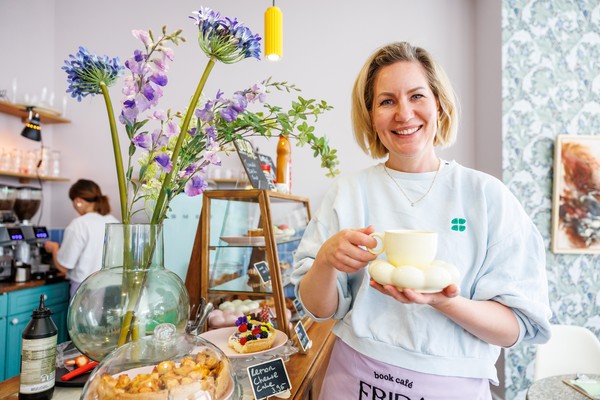
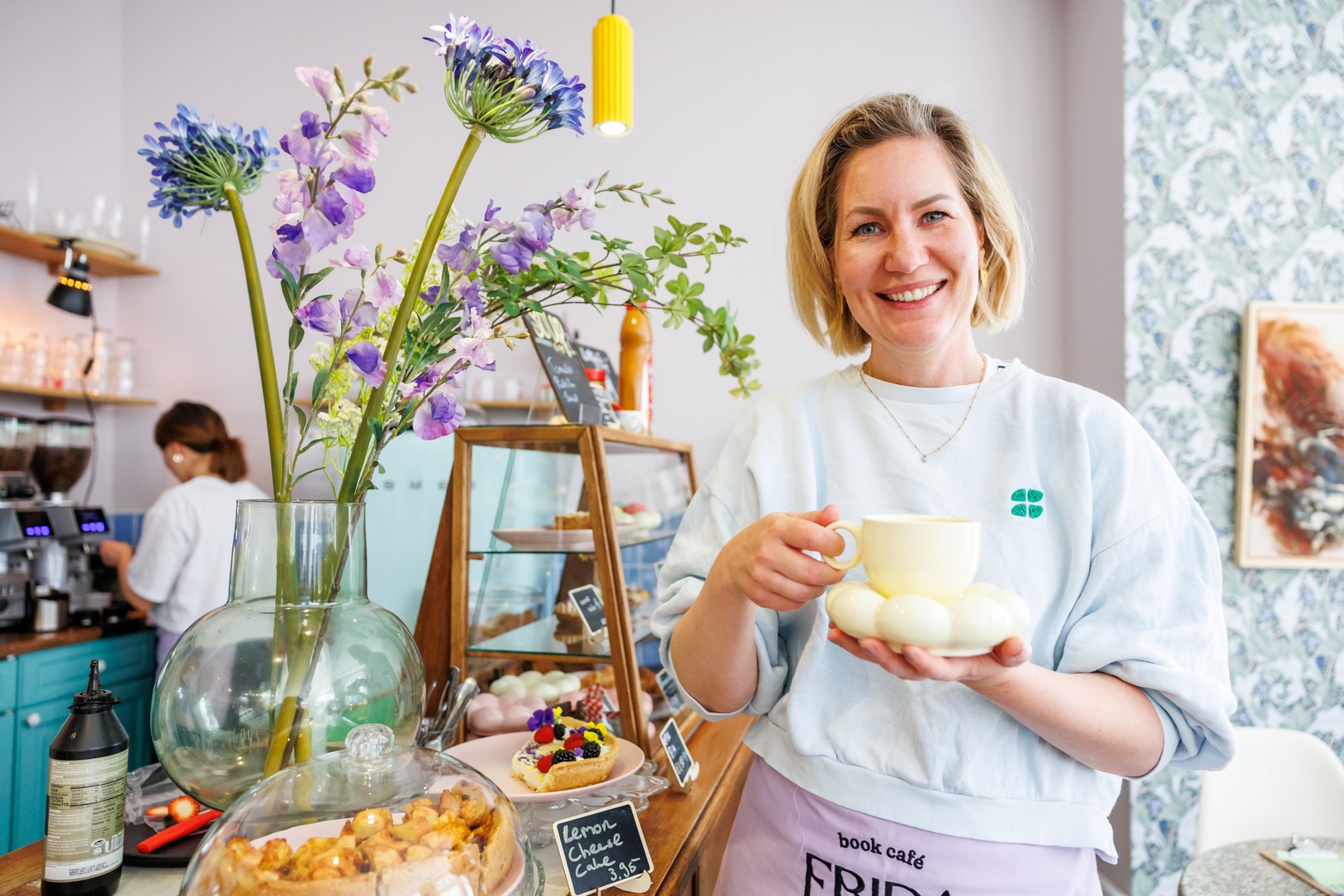
During the interview, she casually folds some laundry in between questions. “Sorry,” she laughs, “but this really has to be done.” It perfectly captures who Gemma Boon (43) is: someone constantly in motion, starting new projects and overflowing with ideas—yet also someone who has created a place where calm and connection take center stage. That place is FRIDA Book Café in Enschede.
Date of Publication: 19 March 2026
Read time +/- 6.8 minutes
Anyone who steps inside FRIDA enters a book café filled with vintage furniture, colorful walls and shelves stacked with books. You can have a coffee, enjoy a simple lunch or quietly read a book. Everything feels intentionally homely. But behind that relaxed atmosphere lies a much bigger idea.
From Art Historian to Community Builder
Gemma moved to Enschede about fifteen years ago. Trained as an art historian, she previously worked at Rijksmuseum Twenthe and is now director of the Stichting Dag van het Kasteel. She also writes columns and is involved in various cultural projects. Yet despite her packed schedule, she ran into something many newcomers recognize: finding a sense of community in a new city is not always easy.
“I kept hearing that from others too,” she explains. “Especially international students and young people who have just moved here often struggle to find a place where they belong.” It brought her back to an old dream. As a teenager, she once talked with a friend about opening a small bookshop. During a difficult period—marked by the pandemic and a burnout—she finally decided to take that idea seriously. “I thought: why wait any longer?”
Meet FRIDA
The result was FRIDA Book Café. The name stands for Food, Reading, Inspiration, Diversity and Art, and also refers to the Mexican artist Frida Kahlo. She was someone who chose her own path early on and played with gender roles,” Gemma says. “FRIDA is also a place where people can truly be themselves. For example, we have many young people with autism or ADHD, and a lot of people from the queer community.”
At the same time, the café is not meant exclusively for specific groups. “It’s important that everyone feels at home here,” Gemma emphasizes.
Many visitors discover FRIDA by chance. They come in for a cup of coffee, a slice of cake or a simple lunch, and are then asked whether they would like to be added to the customer system. “We call that: Meet FRIDA,” Gemma explains. Those who feel increasingly involved often take the next step—Become FRIDA.
Each year, around a hundred volunteers are active within the foundation, most of them young people between eighteen and thirty years old. A striking number are international students. “We even have a waiting list for volunteers,” Gemma says. “I know—that’s a real luxury problem these days.”
A Collective Effort
When Gemma first moved into the building, it was completely empty. She furnished most of the café herself, using vintage furniture and second-hand finds. “My old fridge is here too,” she says with a laugh. But FRIDA is never finished. The interior changes regularly, often with help from volunteers. “I don’t want this to be a place that belongs only to me, where I decide everything. It has truly become a shared project, with room for new ideas all the time.”
Dreams for the Future
FRIDA’s impact has not gone unnoticed. In March 2026, Gemma was named Vrouw van het Jaar Twente (Woman of the Year Twente), and in September 2025 she won the Ignite Award—a national entrepreneurship prize for initiatives with social impact. The award came with an investment budget of €100,000, which Gemma is using to further expand the concept.
A second FRIDA location is planned in Nijmegen, and ultimately she hopes to roll out FRIDA in multiple places across the Netherlands. “The goal is to have ten locations eventually,” she explains. “With a national foundation on top, which I will lead. Each FRIDA will operate independently, but I will be responsible for safeguarding the visual identity and overall methodology.”
Despite its success, founding FRIDA was not without challenges. In the early stages, Gemma invested all her personal savings into the project and raised additional funding through crowdfunding. The first year was financially intense. “There were definitely moments when I wondered: am I really going to pull this off?” she admits. But quitting was never an option. “Not just my savings were at stake, but also the trust of a whole group of people who volunteer here.” At times, she says, that pressure was heavy.
“Many people initially thought: nice, a little bookshop. But explaining the concept behind it was quite difficult. And getting funding for a bookshop? That felt odd to many.” Still, she persisted. “Sometimes it’s probably a good thing that you don’t know exactly what lies ahead.”
Feeling at Home in Twente
By now, Gemma feels completely at home in Twente. “People often say that Twentenaren are reserved, but I don’t recognize that at all. In The Hague—where I lived before—people don’t even know their neighbors.” According to her, newcomers simply need to take the initiative to meet others.
And that is exactly what FRIDA stands for. “My love for books, art and community-building all come together here,” Gemma says. “And the most beautiful part is that this place is now being created by so many people together.”
Share article on:
Elke Agten
Gemma Boon